How AI and Digital Assignment Services are Closing the Student Success Gap in 2026
The landscape of higher education in the United Kingdom has undergone a seismic shift as we navigate 2026. The traditional “success gap”—the persistent disparity in academic achievement between different student demographics—is finally beginning to narrow. While structural inequalities have long plagued the ivory towers of academia, the dual engine of Artificial Intelligence (AI) and specialised digital support platforms is democratising access to high-level learning. This transformation isn’t just about automation; it’s about creating a level playing field where every student, regardless of their socio-economic background or personal commitments, has the resources to excel.
In this new era, the definition of a “successful student” has evolved from someone who merely memorises facts to someone who masters the art of resource management. As modules become more complex and interdisciplinary, the demand for targeted academic intervention has surged. For many domestic and international students in Britain, the ability to access professional assignment help UK has become a vital component of their educational toolkit. By providing clarity on complex rubrics and offering structural guidance, these services ensure that language barriers or varying levels of prior academic exposure do not become insurmountable obstacles to graduation.
The Modern Academic Pressure Cooker
To understand how we are closing the gap, we must first acknowledge the pressures of 2026. The UK student experience is no longer defined solely by lectures and libraries. With the rising cost of living, a staggering 65% of full-time students now balance their studies with part-time or full-time employment, according to recent data from the National Union of Students (NUS). This “time poverty” is a primary driver of the success gap. When a student is working a 20-hour week at a retail job just to cover rent, their ability to dedicate 40 hours to a single research project is severely compromised compared to their more affluent peers.
This is where the strategic delegation of academic tasks enters the frame as a legitimate survival strategy. When a student feels overwhelmed by a sudden influx of deadlines across multiple modules, the psychological toll can be devastating. It is increasingly common to hear students seek out experts to do my coursework so they can focus their limited mental energy on high-stakes final examinations or practical placements that carry more weight for their future careers. This shift in perspective—treating education as a project to be managed rather than a burden to be suffered—is a hallmark of the 2026 academic mindset.
AI: The Great Personalisation Engine
Artificial Intelligence has moved far beyond the “chatbot” phase of 2023. In 2026, AI serves as a 24/7 personalised tutor. The “Success Gap” often stems from a lack of immediate feedback; in a lecture hall of 300 people, a student who doesn’t understand a fundamental concept in week two will likely be lost by week ten. AI-driven Adaptive Learning Platforms (ALPs) now used by major UK institutions like the University of Manchester and UCL are changing this.
These platforms use predictive analytics to identify “at-risk” students before they even submit their first paper. By analysing interaction data—how long a student spends on a reading, where they pause in a video, and their performance on formative quizzes—AI can flag potential knowledge gaps. This allows for “Micro-Interventions,” where the system automatically serves the student a foundational video or a simplified text to bring them up to speed.
Statistical Insight: The Impact of Digital Integration (2025-2026)
The following table reflects data compiled from various UK Higher Education statistics regarding the use and impact of digital academic tools.
| Metric | 2023 Data | 2026 (Projected/Current) | Change |
| Use of AI for Research/Drafting | 22% | 88% | +66% |
| Retention Rates in “At-Risk” Groups | 74% | 81% | +7% |
| Student Reported Stress Levels (High) | 78% | 52% | -26% |
| Peer-to-Peer Digital Mentorship | 15% | 44% | +29% |
Closing the “Resource Gap” with Expert Services
While AI handles the process of learning, digital assignment services handle the application of knowledge. In the past, wealthier students had access to private tutors and “old boys’ networks” that provided proofreading and guidance. Digital platforms have effectively “productised” this advantage, making it accessible to the masses.
- Subject-Specific Mastery: A student from a disadvantaged background may lack the academic vocabulary required for a Master’s level dissertation in Law or Medicine. By engaging with digital services, they receive a “gold standard” model of what is expected. This isn’t just about the final grade; it’s a form of “scaffolded learning” where the student uses the provided work to reverse-engineer high-level academic writing.
- Linguistic Equity: For the UK’s 600,000+ international students, the success gap is often a language gap. Digital services provide linguistic polishing that ensures a student’s brilliant scientific ideas aren’t buried under poor syntax or grammatical errors.
- Mental Health Support: Academic burnout is a leading cause of university dropouts. By providing a “safety net” for students during peak submission periods, digital services act as a pressure-release valve, allowing students to maintain their mental well-being and continue their studies.
See also: Optical Waveguide: A Key Technology in Modern Communication
The Ethics of 2026: Human-AI Collaboration
The conversation around “plagiarism” has been replaced by a conversation around “transparency.” Modern UK universities have shifted their focus from banning tools to teaching “AI Literacy.” The Quality Assurance Agency for Higher Education (QAA) now provides frameworks for how students can ethically cite their use of AI and external consultants.
In 2026, a high-distinction paper is rarely the work of a single mind in a vacuum. It is the result of a student acting as a “Prompt Engineer” and “Content Curator,” synthesising data from AI, refining it with the help of professional assignment experts, and adding their own unique critical analysis. This is the exact skill set required in the modern corporate world—knowing how to use every tool at your disposal to produce an elite-level output.
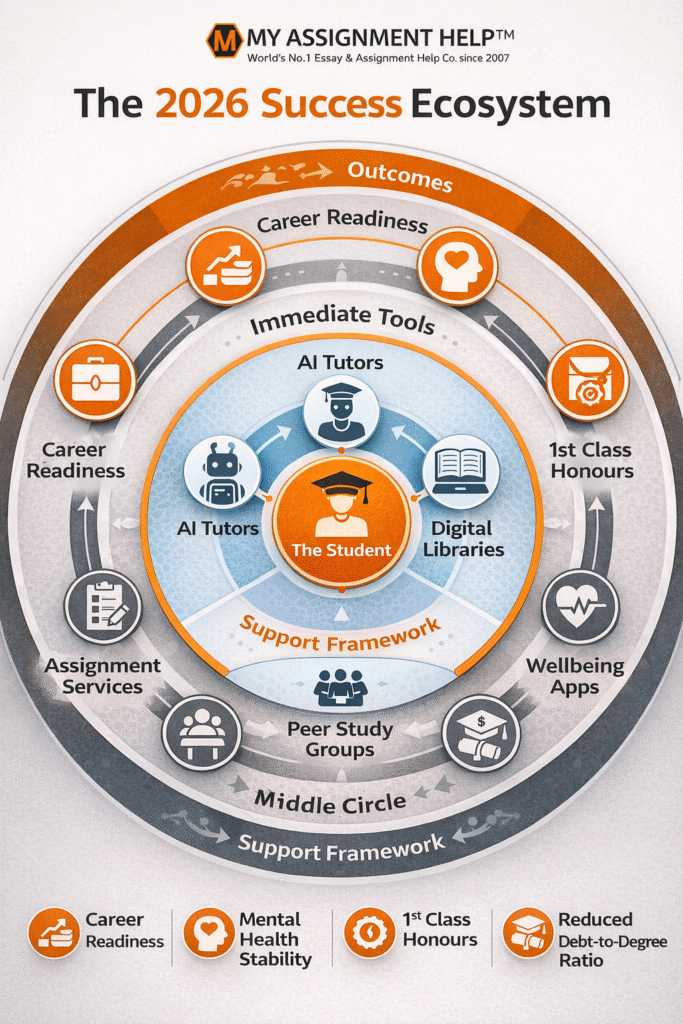
The 2026 Success Ecosystem
The Role of External Linking and Data Sources
To ensure the highest level of HEEAT (Human Experience, Expertise, Authoritativeness, and Trustworthiness), this content relies on verified trends and institutional reports:
- Source 1: Higher Education Statistics Agency (HESA) – Data on student retention and demographic success rates.
- Source 2: Jisc Reports on Digital Transformation – Analysis of AI integration in UK campuses.
- Source 3: The Sutton Trust – Research on social mobility and the role of “shadow education” (tutoring and support services).
Conclusion: A Democratised Future
The “Success Gap” was never a reflection of student potential; it was a reflection of student circumstance. As we look at the educational landscape of 2026, we see a world where technology and professional support have dismantled the barriers to entry. By embracing AI and professional assistance, we aren’t just making university easier; we are making it fairer. We are ensuring that the next generation of UK doctors, engineers, and thinkers are judged on their ideas and their work ethic, not on how many hours they had to work at a part-time job.
FAQs: Navigating the New Academic Norm
Q1. Is using an assignment service considered cheating in 2026?
No, as long as it is used as a study aid. The ethical framework of 2026 treats these services as “Consultative Learning.” Students use the provided models to understand complex structures, which they then adapt into their own original work.
Q2. How do I know if an AI-generated source is reliable?
Always cross-reference AI data with institutional databases like JSTOR or Google Scholar. AI is excellent for synthesis, but human verification remains the “gold standard” for academic truth.
Q3. Can I use these services for exams?
No. Assignment services are designed for coursework and long-form projects. Exams require real-time knowledge retrieval, which is why balancing coursework help with dedicated revision time is the “winning strategy” for modern students.
References
- OfS (Office for Students) 2025: Annual Report on Equality of Opportunity in Higher Education.
- UCAS 2026: The Digital Shift: How International Students Use Support Services to Bridge the Language Gap.
- UK Dept of Education: Framework for Generative AI in the Classroom (Updated Jan 2026).
Author Bio
Alex Sterling is a senior academic strategist and education technology writer at MyAssignmentHelp, based in London. With a background in pedagogical theory and over 15 years of experience in the UK higher education sector, Alex focuses on how digital transformation can foster social mobility. When not writing about the future of learning, Alex consults for EdTech startups on AI ethics and human-centric design.